- Feb 25, 2025
The Truth About Hula Hooping: There’s No Wrong Way to Move!
- Bee Varga
- 0 comments
The fitness world today is filled with conflicting advice, often driven by influencers chasing clicks rather than true education. “Don’t do this!” and “You’re doing it wrong!” are common phrases designed to grab attention, but in reality, movement is far more flexible than these black-and-white claims suggest. When it comes to hula hooping, the truth is simple: if your hoop stays up, you’re doing it right!
Understanding How Your Feet Affect Your Hooping
Where you place your feet while hula hooping directly impacts how your body moves to keep the hoop spinning.
Feet apart: Your hips naturally swing side to side. This stance increases your range of motion, making it easier to keep the hoop going.
One foot forward, one foot back: Your hips will rock front to back, creating a different type of momentum.
Feet together: Your range of motion decreases, making movement more subtle.
Moving in a circle: This is often how absolute beginners instinctively move. It’s not wrong! It helps develop balance and rhythm.
Experimenting with foot placement can make hooping feel more natural and comfortable while also helping to prevent strain or fatigue.
The Science Behind Learning Through Mistakes
Dropping your hoop? Great! Science says mistakes are a crucial part of learning. When we struggle with a movement, our brain forms new neural connections through a process called neuroplasticity. Research has shown that making errors actually helps the brain adjust, adapt, and improve coordination over time (Merriam et al., 2018).
If you stress over dropping your hoop, your sympathetic nervous system (the “fight or flight” response) gets activated, making learning harder. Relax, have fun, and embrace the learning process!
Preventing Overuse Injuries with Variety
One of the biggest mistakes in hula hooping isn’t moving the “wrong way” but rather moving in only one way. Repetitive motion can lead to overuse injuries, much like running on hard pavement or doing excessive crochet without hand breaks.
To protect your body:
Change the angles of your hoop and experiment with different foot positioning & see how many different ways you can move and still keep your hoop going
Try spinning on different body parts (arms, legs, chest).
Incorporate a variety of movements to avoid repetitive strain.
Think of your body like a car tire—wearing down one area too much can cause imbalances. Mixing up your movements ensures balanced muscle development and reduces injury risks.
Congratulations, You’re Already Winning!
The fact that you’re taking action, trying to improve your fitness, and learning something new means you’re already successful. Keep going, experiment, and enjoy the process. There’s no single correct way to hula hoop—there’s just movement, fun, and growth. Keep spinning, keep learning, and most importantly, keep having fun!
References
Merriam, E. P., et al. (2018). Making Mistakes Enhances Learning: Evidence from Neuroplasticity. eLife, 31789. https://doi.org/10.7554/eLife.31789
Maas, E., Robin, D. A., Freedman, S. E., & Ballard, K. J. (2008). Principles of Motor Learning in Treatment of Motor Speech Disorders. American Journal of Speech-Language Pathology, 17(3), 277-298. https://doi.org/10.1044/1058-0360
Krakauer, J. W., & Shadmehr, R. (2006). Consolidation of Motor Memory: The Overlooked Role of Error. Journal of Neuroscience, 26(29), 7452-7456. https://doi.org/10.1523/JNEUROSCI.2214-06.2006
Kleim, J. A., & Jones, T. A. (2008). Principles of Experience-Dependent Neural Plasticity: Implications for Rehabilitation After Brain Damage. Journal of Speech, Language, and Hearing Research, 51(1), S225-S239. https://doi.org/10.1044/1092-4388
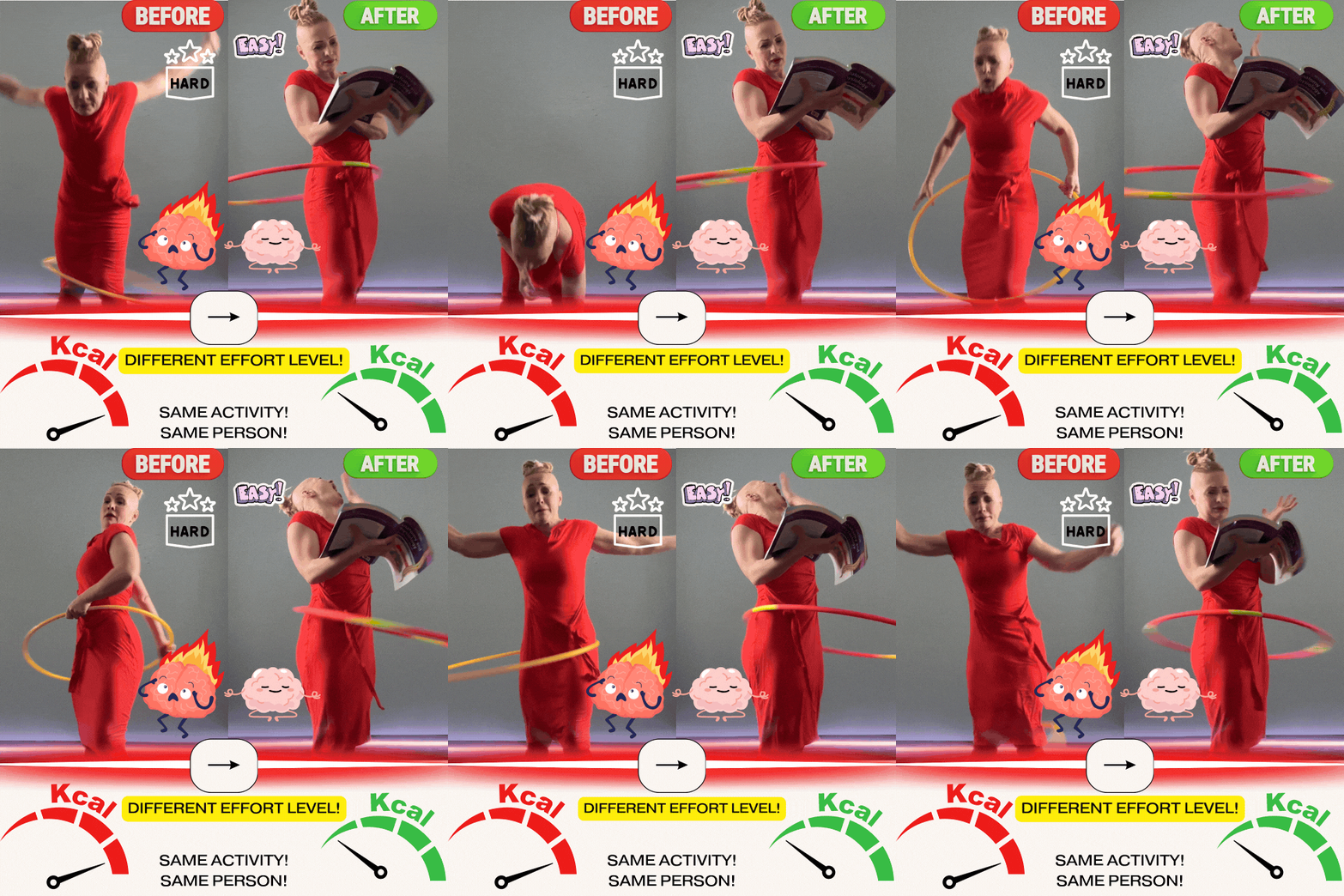
How can the same person doing the same activity burn more or less calories? Why do we stop burning the calories when hula hooping? Find out now!